 |
 |
 |
 |

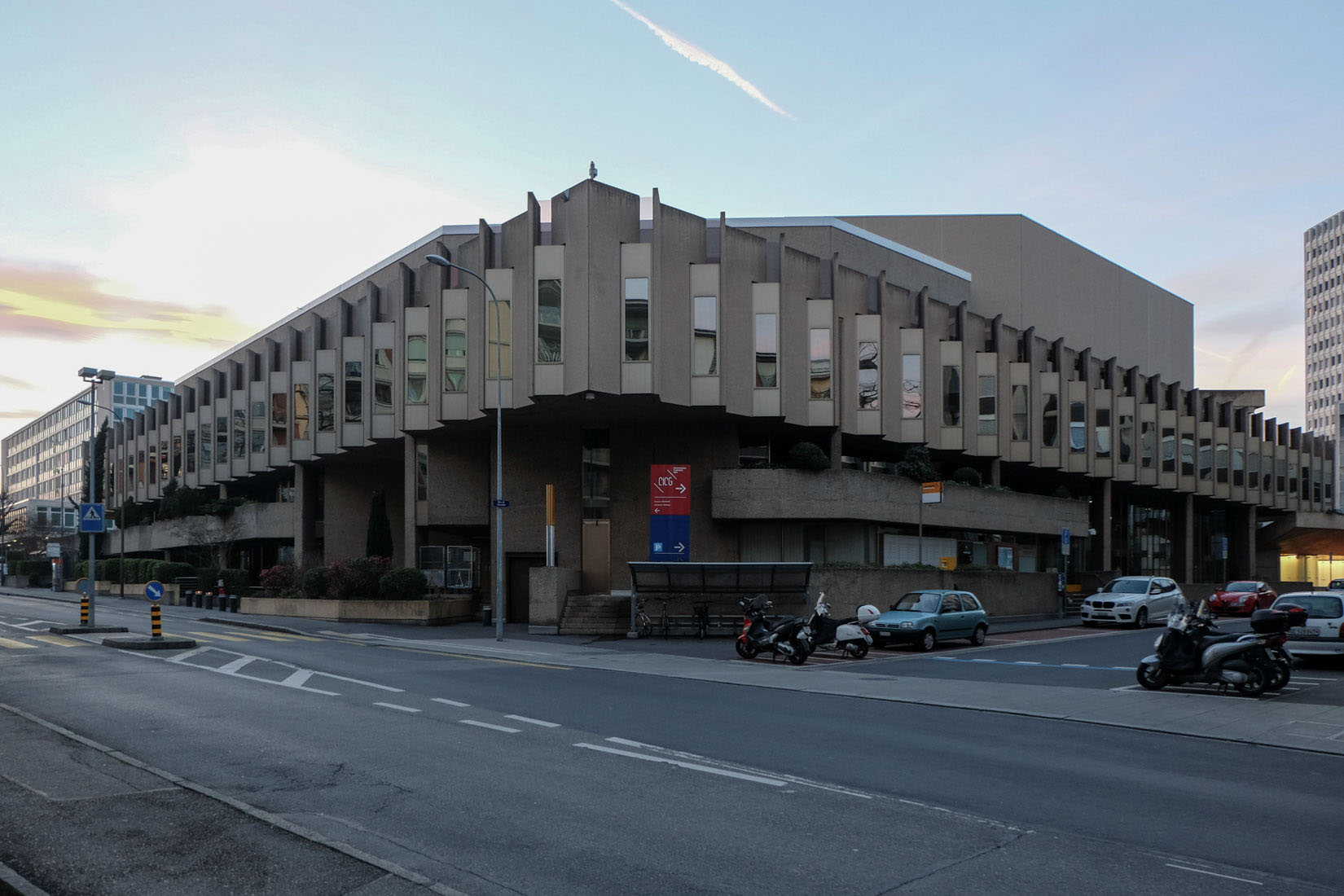
Alberto Camenzind - Switzerland
CICG - Centre International de Conferences de Geneve
Rue de Varembe 15-17, chemin Louis-Dunant 2, Geneva
1968 - 1973
The
Geneva International Conference Center was the result of a
collaboration between André
and Francis Gaillard with Alberto
Camenzind. The design is the result of a successful
entry in the architectural competition. The building is
located on a corner of the site that is mainly used by the
administrative activities of international organisations. The
architects proposed a solution in which the entire programme
is organised alongthe Diagonale. The main components of the
spatial programme include an auditorium with 800 seats and a
conference room with 400 seats. The floor plan consistently
follows the 45° angle in its organisation. The circulation
spaces are placed around the two main volumes. This design
strategy places the actually secondary spaces such as stairs,
restaurant, etc. on the periphery. Despite the high density of
the space programme, the architects succeed in accommodating
all the rooms within a small area. The external appearance of
the building is characterised by the use of bush-hammered
reinforced concrete. On the main level, a jagged ground plan
is created by turning the concrete façade by 45°, with a
consistent alternation between windows and infill. Below this
floor, the façade jumps back a little and forms a freely
articulated plinth. The building was later remodelled several
times and adapted to the changing requirements of a conference
centre. In particular, the main entrance was redesigned.
Das
Geneva International Conference Center entstand aus einer
Zusammenarbeit zwischen André
und Francis Gaillard mit Alberto
Camenzind. Der Entwurf ist das Ergebnis eines
erfolgreichen Beitrags zum Architekturwettbewerb. Das Gebäude
befindet sich auf einer Grundstücksecke, welche hauptsächlich
von den administrativen Aktivitäten internationaler
Organisationen genutzt wird. Die Architekten schlugen eine
Lösung vor, in welcher das gesamte Programm an der Diagonale
organisiert wird. Zu den wichtigsten Bestandteilen des
Raumprogramms gehören ein Auditorium mit 800 Sitzplätzen und
ein Konferenzraum mit 400 Sitzplätzen. Der Grundriss folgt in
seiner Organisation konsequent dem 45° Winkeln. Dabei werden
die Zirkulationsräume um die beiden Hauptvolumen gelegt. Durch
diese Entwurfsstrategie gelangen die eigentlich sekundären
Räume wie Treppen, Restaurant, etc. an die Peripherie. Trotz
der hohen Dichte des Raumprogramms gelingt es den Architekten,
alle Räume auf einer kleinen Fläche unterzubringen. Die
äussere Erscheinung des Gebäudes wird geprägt durch die
Anwendung von gestocktem Stahlbeton. Auf der Hauptebene
entsteht durch das Abdrehen der Betonfassade um 45° ein
gezackter Grundriss, wobei sich konsequent ein Wechsel
zwischen Fenster und Füllung zeigt. Unter diesem Stockwerk
springt die Fassade etwas zurück und bildet einen frei
artikulierten Sockel. Das Gebäude wurde später mehrfach
umgebaut und an die wandelnden Anforderungen eines
Konferenzzentrums angepasst. Insbesondere wurde der
Haupteingang neu gestaltet.